

“Until the philosophy which holds one race superior and another inferior is finally and permanently discredited and abandoned, everywhere is war. And until there are no longer first-class and second-class citizens of any nation, until the color of a man’s skin is of no more significance than the color of his eyes. And until the basic human rights are equally guaranteed to all without regard to race, there is war. And until that day, the dream of lasting peace, world citizenship, rule of international morality, will remain but a fleeting illusion to be pursued, but never attained... now everywhere is war.”
Ethiopian Emperor Haile Selassie I delivered this speech at the United Nations in 1963; Bob Marley and the Wailers later adapted it into the song “War.”
“War” often comes to mind when I read about the Maafa, and I encounter the phrase, “one of the most violent.”
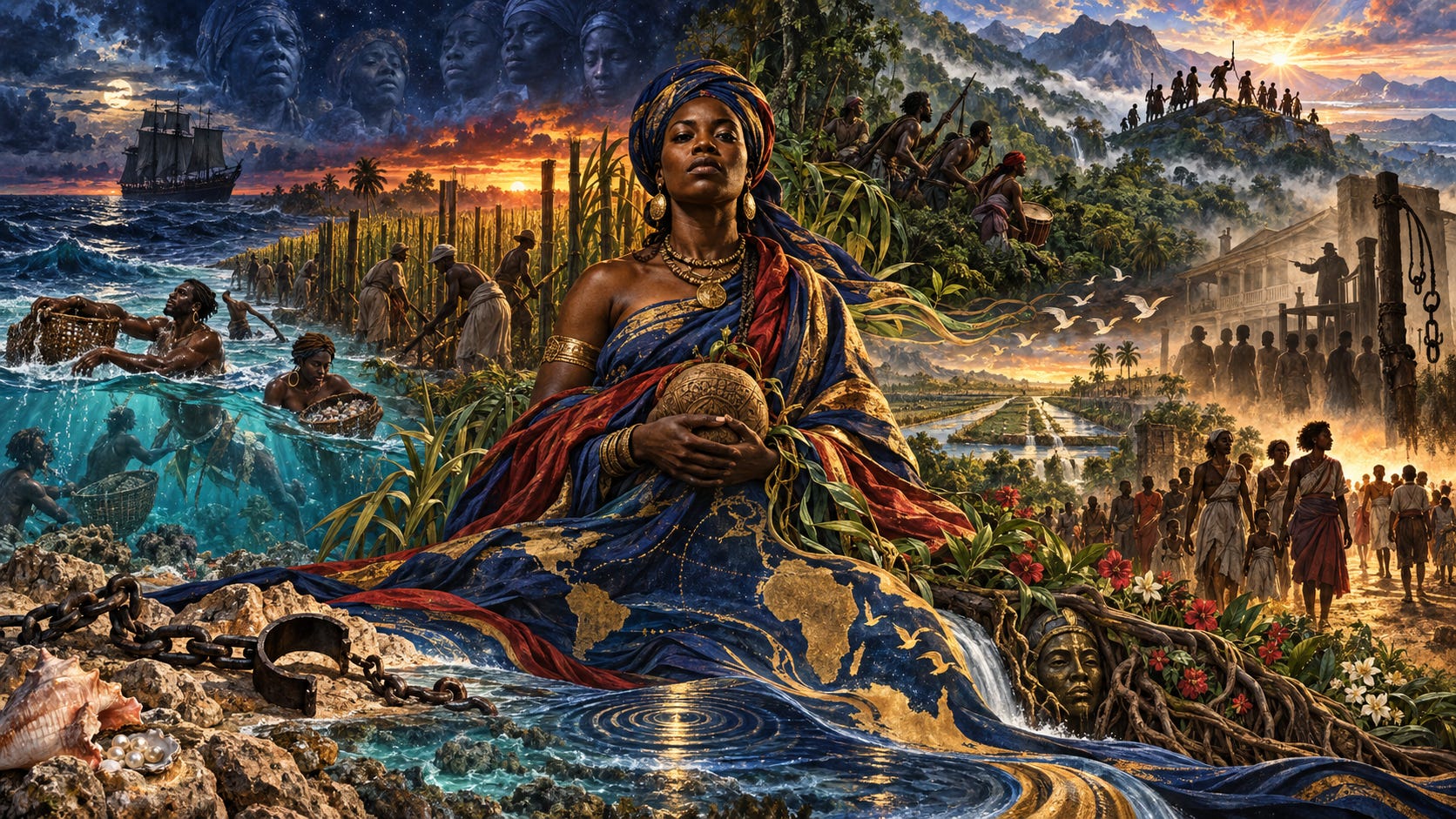
Accounts of the Haitian Revolution frequently describe Saint-Domingue—as the French called it, and from which Haiti emerged—as “one of the most violent” plantation societies in the Black Atlantic world. This phrase captures the terror and intensity of a system of captivity imposed by those who considered themselves superior to those they regarded as inferior. Haiti’s extraordinary wealth came at a horrific human cost. The sugar and coffee economy depended on forced labor, relentless oppression, the trafficking of vast numbers of Africans, hunger, disease, brutal punishments, sexual violence, and premature death. On the eve of the Revolution, Haiti’s prosperity was inseparable from a social order in which the overwhelming majority of the population lived in captivity.
Yet, the phrase becomes troubling for any reader who looks beyond Haiti.
This same language surfaces in histories of Barbados, Jamaica, Demerara, the plantation South of the United States, and other territories within the Black Atlantic world where Africans were held in bondage. Go further back to the early Caribbean under Spanish oppression, and the pattern re-emerges in accounts of Margarita’s pearl fisheries, where the pursuit of wealth depended on the coerced and perilous labor of Indigenous and African peoples.
In every location, a variation of the claim appears: here, perhaps, the Maafa at its most violent; here, one of its most lethal manifestations; here, a uniquely savage regime.
This repetition reveals something very unsettling. The Atlantic system of captivity did not produce a single, isolated theater of exceptional cruelty. Again and again, it generated regimes where extraordinary violence was not accidental, peripheral, or simply the result of especially sadistic individuals, as some would have us believe. Violence was woven into the production of wealth and sustained by a false ideology of superiority. Dehumanization permeated the law, trade, landholding, credit, military aggression, racial classification, and the daily organization of labor.
This is one reason I find the phrase “one of the most violent” troubling. It can imply a contest in suffering, as if the task were to determine whether Haiti, Jamaica, Barbados, Demerara, the Deep South, or Margarita should claim the highest place on a scale of horror. Such ranking is neither possible nor especially illuminating. It risks reducing our istwa (histories) to a competition of injuries and obscuring the particular forms of European violence, tyranny, and barbarism.
A more meaningful question is not which Maafa society was “one of the most violent” but how violence was organized in each context. What forms of labor were imposed? How were people fed, housed, punished, trafficked, separated, surveilled, taxed, recruited, transported, or coerced? What demands did the local ecology place on their bodies and lives? How did colonial law shield the perpetrators? And how did the oppressed resist, endure, forge relationships, preserve memory, and create possibilities for freedom under systems designed to strip them of their humanity?
In Haiti, the answer begins with plantation agriculture. By the late eighteenth century, the ancient land seized from Anacaona’s people had become one of the most profitable centers, especially in sugar and coffee. Its wealth relied on the forced importation of Africans in staggering numbers, because the population often failed to reproduce at rates sufficient to sustain the plantation economy. High mortality was intrinsic to a system built on exhausting labor, hazardous conditions, meager provisions, rampant disease, and a cold logic of replacement. New captives could be trafficked in; the dead were calculated as mere losses. Haiti’s violence was not confined to the whip, the prison, the execution ground, or the mutilated body. It was embedded in the everyday normalcy of a regime that treated human lives as expendable inputs for expanding plantation wealth. Because of the extraordinary wealth carved out of human suffering, the French called Haiti “La Perle des Antilles” (the “Pearl of the Antilles”).
This takes me to Margarita.
Margarita Island (Isla de Margarita) was one of the earliest and most significant pearl-fishing zones in the Caribbean, later becoming a hub for both legal and illicit trafficking of people between Spanish- and non-Spanish-beseiged areas. Soon after Columbus’s third voyage, Spaniards identified Margarita and neighboring Cubagua as part of a “Pearl Coast” whose oysters became a major early source of revenue for the Spanish between roughly 1508 and 1531. To exploit these beds, Spaniards captured Indigenous people locally and from other regions (notably Lucayo), forcing them into perilous and grueling diving labor.
Thus, Margarita complicates the familiar image of Atlantic captivity by highlighting forms of extraction that extended beyond the cane fields.
The environmental and human toll was severe. Primary accounts highlight relentless overwork, violence, and the rapid demographic collapse of Indigenous communities, which occurred alongside the depletion of oyster banks. As European “superior” diseases reduced Indigenous populations, Spaniards increasingly turned to Africans for pearl diving and related tasks on Margarita and Cubagua.
On Margarita, coerced pearl divers—both Indigenous and African—labored from canoes under the watchful eyes of overseers, diving on breath-hold to successive, pre-inspected oyster beds until each was depleted. Contemporary accounts emphasize the brutality of this system: divers were frequently chained at night to prevent escape, and faced death or lasting injury through drowning, exhaustion, exposure, repeated immersion, marine hazards, and the physical demands of relentless breath-hold diving. They often worked from sunrise to sunset. Those who resisted or failed to meet quotas could be beaten. The pearls that entered European markets thus carried with them the hidden histories of forced underwater labor, captivity, and resistance. We could call them “blood pearls.”
Barbados, too, was forged through a brutal plantation regime. It became an early testing ground for English colonial sugar production, establishing legal and commercial practices later replicated throughout the Atlantic under British oppression. Barbados’ small land area, intensive cultivation, and densely packed plantation society produced a climate of constant surveillance and relentless demands for sugar. While escape was not impossible, Barbados’s compactness made prolonged flight and maroonage far more difficult than in larger, more mountainous regions. The result was that punishments such as beatings, branding, and burning alive were accepted responses to a range of infractions. There were few, if any, legal restrictions on the extreme cruelties that developed in the plantation zones: some Bajans were covered in honey and staked on ant hills to be stung to death; gunpowder was forced into bodily orifices and ignited; others were compelled to eat their own amputated limbs. The Buckra (a widely used epithet for Europeans, derived from a West African term meaning demon—a powerful, evil being to be contained, manipulated, or banished) would cut off ears, slit nostrils, and brand cheeks. One observer estimated that on many large plantations, sixty or more punishments occurred daily, as these “superior” evil beings believed that violence was essential for their own security.
Similar patterns of violence permeated Jamaica, where “the whip is the soul of the colonies.” Yet Jamaica’s rugged mountains, dense forests, and remote interiors provided vital spaces for Xaymacans to assert and defend autonomy. The emergence and endurance of maroon communities stand as undeniable proof of resistance to punishment, hunger, forced labor, and pervasive violence. The colonial state’s relentless campaigns against the Maroons demonstrate that Xaymacans refused to remain confined within the limits set by their oppressors. Against formidable odds, they forged freedom, protected it fiercely, and compelled the buckra (demons) to recognize—if only partially and reluctantly—the boundaries of colonial violence.
Demerara offers yet another landscape of violence, frequently described as one of the most brutal, lethal, and intensely exploited sugar regimes. Its plantation economy developed on coastal terrain that demanded intricate drainage, canals, dykes, and tightly managed water systems. Captive Guyanese people were forced to labor within this engineered environment, constantly maintaining the very infrastructure that enabled colonial production. The 1823 Demerara uprising, which mobilized thousands, exposed both the depth of collective resistance and the ferocity of the colonial crackdown. In its wake came killings, executions, and widespread terror, all designed to reassert the dominion of the buckra.
The plantation South of the United States must also be understood in terms of its diverse local forms rather than as a monolithic system. Rice cultivation in the Carolina and Georgia lowcountry, tobacco in Virginia and Maryland, cotton in the expanding southern territories, sugar in Louisiana, urban and domestic slavery, skilled labor, hiring out, and internal trade all created distinct conditions. Yet beneath this variety lay a shared legal and economic foundation: human beings were treated as property, with others possessing legal claims over their labor, movement, relationships, sexuality, and futures. Domestic trafficking made the violence of this system unmistakable. Individuals could be trafficked away from parents, children, partners, and communities; family separation was not an incidental outcome but a central, deliberate feature of this corrupt and appalling system. There are many stories of women and girls being violated as they are trafficked to the Deep South.
Viewed together, these histories defy simple comparison. Haiti was undeniably a site of extraordinary brutality, but it did not hold a monopoly on violent plantation life—nor did Barbados, Jamaica, Demerara, the U.S. South, or Margarita. Wherever buckra asserted his false superiority, death, destruction, and violence followed. Sadism permeated every region. In one place, the main burden might be cane cultivation and the machinery of sugar; in another, rice fields, cotton expansion, drainage canals, pearl diving, or the commerce that tore families apart. Across all these sites, the system relied on compelling people to labor for others’ wealth while denying them secure possession of their own bodies, time, children, homes, and futures.
This is why the word Maafa is vital for making the scale of this reality visible. Derived from Kiswahili and often translated as “great disaster” or “great tragedy,” Maafa has been adopted by scholars, writers, and communities to name the African catastrophe of captivity, transatlantic trafficking, colonialism, and their enduring consequences. In an account recalled by the African-centered scholar Marimba Ani, a young woman approached her and asked how she knew to use the words maa and fa, saying that in her people’s Bantu language, maa meant humanity and fa meant to kill. Read through that understanding, the Maafa signifies not only calamity but the attempted killing of African humanity itself.
This is why Hunter Adams’s term humanicide is so resonant. It directs attention beyond the murder of individual people towards an attempted assault upon a people’s collective humanity: their families, societies, cultures, languages, historical continuities, and future possibilities. Thus, Maafa does not identify local differences; it connects them. It insists these were not isolated colonial episodes, but parts of a vast, connected historical process of exploitation, and more crucially, violence.
Put another way, the Maafa was a systemic, transregional architecture of violence: an interlocking order of racial hierarchy, captivity, extraction, commerce, law, military force, and colonial aggression. It changed its local form—sugar cultivation in Haiti and Barbados, pearl extraction around Margarita, plantation labor in Jamaica and Demerara, and rice, tobacco, cotton, and domestic trafficking in the United States—but its purpose remained constant: the conversion of African lives, labor, kinship, land, and futures into wealth and power for others.
From this perspective, the repeated claim that every place reveals the Maafa at its “most violent” shows the system’s deliberate, structural nature. It exposes the vast reach of a system that could generate wealth in radically different settings while consistently inflicting severe bodily suffering, social death, dispossession, and terror. What varied from place to place was not the existence of violence, but how it was organized, justified, and experienced—and how people resisted it.
The Haitian Revolution stands alone because the people of Haiti did more than resist an intolerable order—they destroyed it, repelled efforts to restore it, and established an independent state in 1804. Yet Haiti’s significance should not foster the misconception that its people revolted because their suffering was uniquely cruel while other captive populations endured less. Across the Atlantic world, Africans and their descendants resisted in ways shaped by local realities: through flight, maroonage, work slowdowns, sabotage, spiritual and cultural survival, family-making, legal petitions, plots, uprisings, military service, political organizing, and outright war.
The profound lesson is that the phrase “one of the most violent” applies anywhere in the Black Atlantic world. Everywhere the Maafa took root, one finds a system that made human suffering central to economic life, and which demanded that everywhere is war. Indeed, the buckra—armed with a philosophy of superiority—was an evil force to be contained, resisted, and ultimately driven from the world.
Thanks for reading,
Ancestral blessings,
Meserette Kentake
Two books that accompanied this piece are:
Brown, Vincent. The Reaper’s Garden: Death and Power in the World of Atlantic Slavery. Cambridge, MA: Harvard University Press, 2008.
Stuart, Andrea. Sugar in the Blood: A Family’s Story of Slavery and Empire. London: Portobello Books, 2012.
The main sources on information about Margarita were:
Cambridge University Press — “Navigating Labour Shifts: Early Modern Pearl Fishing in the Caribbean, 1521–1563.”
Scholarly article covering Cubagua, Margarita, Coche, Cabo de la Vela, and Riohacha; particularly useful for Indigenous displacement, enslaved labor, debt bondage, convict labor, and the organization of pearl fishing.
https://www.cambridge.org/core/journals/international-review-of-social-history/article/navigating-labour-shifts-early-modern-pearl-fishing-in-the-caribbean-15211563/0CD94BA698F1762C68C23D3ACCAC3161cambridge
NOAA — “History of the Atlantic Pearl-Oyster, Pinctada imbricata.”
A technical historical overview with valuable material on the Margarita–Cubagua–Coche fishery. It explicitly notes the enslavement of Indigenous divers, their later replacement by African slaves, and the 1558 royal decree restricting pearl fishing to Black laborers.
https://spo.nmfs.noaa.gov/sites/default/files/pdf-content/MFR/mfr651/mfr6511.pdfspo.nmfs.noaa
Slavery Images — “Pearl Fishing, Margarita Island, Venezuela, 1560s–1570s.”
Provides a historical image and translated descriptive text about Black divers collecting pearls near Margarita and the Venezuelan coast. Its page also points to Molly Warsh’s peer-reviewed article, “Enslaved Pearl Divers in the Sixteenth Century Caribbean,” published in Slavery & Abolition (2010).
https://www.slaveryimages.org/database/image-result.php?objectid=212slaveryimages
JSTOR — “Margarita Island, Exporter of People.”
Useful chiefly for the island’s longer demographic and migration history, rather than as a primary study of slavery. Access may require an institutional or personal JSTOR subscription.
https://www.jstor.org/stable/165082jstor