

We shall return
To the houses, to our crops,
to the beaches, to our fields
we shall return
To our lands
Red with coffee
White with cotton
Green with maize fields
we shall return
To our mines of diamonds
Gold, copper, oil
we shall return
To our rivers, our lakes
our mountains, our forests
we will return
To the shade of the mulemba
To our traditions
To the rhythms and bonfires
we shall return
To the marimba and the quissange
to our carnival
we shall return
To our beautiful Angolan homeland
our land, our mother
we shall return
We shall return
to liberated Angola
independent Angola.
Poem by António Agostinho Neto
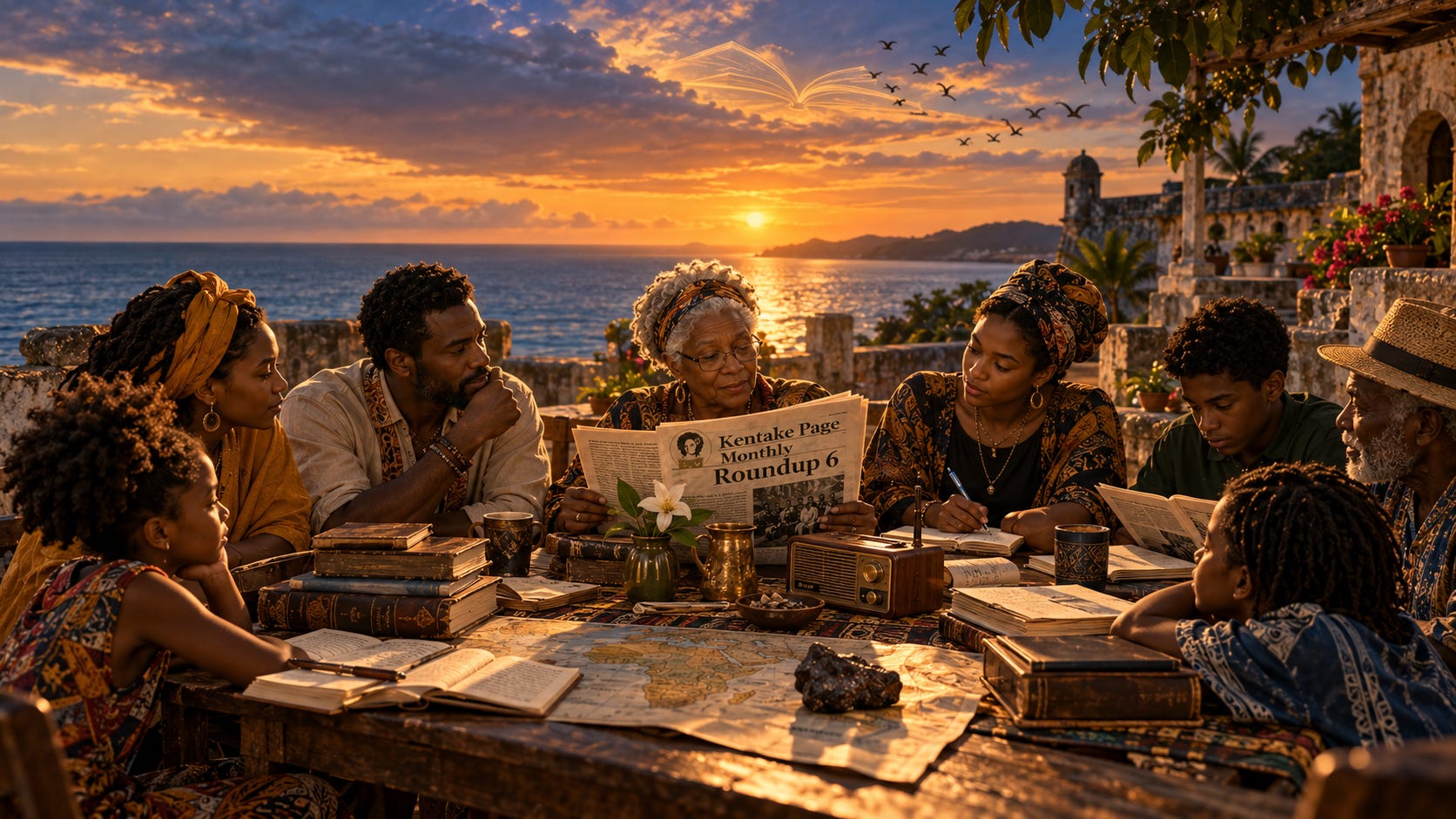
Kentake Page (KP) now has 792 published posts, with an additional 183 posts in draft form. Writing “My Top Ten Black History Stories” made me realize just how many stories still remain unpublished—beyond even those waiting in my drafts. In September, I set out to address this backlog. My primary focus was a post on Sam Sharpe. I published two pieces on KP: one exploring the Baptist War/Christmas Rebellion as a collective Jamaican struggle for freedom, and another—a biographical essay—highlighting Sam Sharpe as a Baptist deacon, strategist, political organizer, and national hero. I approached the Baptist War post with care, drawing information from books in my personal library rather than relying on online research.
Whenever I reflect on Sam Sharpe, my mind inevitably turns to Harriet Tubman. It is remarkable that both reached the same profound political and moral conviction: that death was preferable to bondage. If you are a reader of the Maafa, you will observe that across the Black Atlantic, our ancestors—though separated by distance and circumstance—could independently reach the same uncompromising conclusion in the face of racial captivity.
At his execution in Montego Bay, Sharpe’s words echoed this resolve:
“I would rather die upon yonder gallows than live in slavery.”
Similarly, when Harriet Tubman reflected on her own decision to self-liberate, she declared:
“I had reasoned this out in my mind; there was one of two things I had a right to, liberty or death; if I could not have one, I would have the other.”
Despite being separated by geography, generation, systems of oppression, and faith—Sharpe in the British Caribbean Baptist tradition, Tubman from Maryland’s Eastern Shore within the U.S. abolitionist movement—their declarations resonate with uncanny similarity. Each claims liberty as an inalienable right, refuses to accept bondage as life, and reimagines death itself as an act of resistance. Their unwavering courage underscores the enormity of the Maafa: a system of violence whose reach and cruelty were boundless.
In the words of “Mrs,” who liberated herself from the USA to Canada: “I look upon [captivity] as the worst evil that ever was. My life has been taken from me in a measure by it. If any are disposed to apologize for [it], it would be well for them to try it awhile.”
I owe Tony Martin a debt of gratitude for many reasons, so I finally dedicated a long-overdue biographical post to him. When Martin passed away unexpectedly, he was in the midst of writing a biography of his aunt, Audrey Jeffers—a work that would have undoubtedly been extraordinary. In tribute to his unfinished project, I also wrote a post honoring Jeffers.
Audrey Layne Jeffers was a pioneering social worker, feminist organizer, educator, and political trailblazer whose work transformed public welfare and redefined women’s civic participation in Trinidad and Tobago.
Continuing to immerse myself in the Caribbean’s intellectual currents, I wrote posts on John Sayers Orr, Édouard Glissant, and Paul Niger. Of these, Glissant is likely the most familiar, along with Niger, both representing the Francophone Caribbean. Coincidentally, I came across a Substack piece by Daniel Osei-Kissi titled “What Is an African?” that featured Glissant. Reading it made me realize that I needed to read Glissant’s books, not tomorrow but today. I have since started his Poetics of Relation, a challenging read because his ideas are as deep as the ocean and remind me of my first encounter with Marimba Ani’s Yurugu.
Sadly, both Orr and Niger are now largely forgotten. Orr is remembered for his connection to the 1856 Angel Gabriel Riots in Guyana. Niger, a Guadeloupean poet and novelist, led a double life: as Thomas Gaston Albert Béville, the colonial administrator, and as Paul Niger, the radical poet fighting against colonialism. Tragically, Niger’s life ended at age 46 in the Air France Flight 117 crash. He was among several anti-colonialists lost in that disaster, leading some to suspect it may have been an assassination.
I was deeply saddened to hear of Cassandra Wilson’s passing. For me, only a handful of singers make it into a dedicated artist playlist, and Cassandra is one of them. I can listen to Cassandra singing all day long. If I had to choose, “Wichita Lineman” would be my favorite song by her. There’s something about that song that stirs something in me, even though I do not have a lineman myself! I believe it’s the emotions the song stirs—the way her deep, smoky, and luminous voice captures yearning and longing so perfectly. For me, “Wichita Lineman” has become a metaphor for the relentless pursuit of a goal.
When I listen to the song in this way, its imagery takes on an entirely new depth.
The lineman’s solitary search— working alone in a vast, empty landscape, looking for a single break in a massive grid —mirrors the lonely, demanding process of striving toward a distant ambition or dream, especially when no one else is there to witness your efforts. The line “I can hear you through the wire” becomes the inner voice of your goal. Even amid the static, distractions, and noise of daily life, that core ambition keeps calling to you, anchoring your focus. When Wilson sings, “And the Wichita lineman is still on the line,” it takes on a double meaning—not just the literal work on the power lines, but also the act of “holding the line” emotionally, refusing to give up even when stretched to the limit. Finally, the song’s most haunting lyric, “I need you more than want you, and I want you for all time,” beautifully expresses how a true life goal can capture you for all time and shape your very identity. Sometimes, I think, I long for Mama Africa more than she longs for me!
Staying Stateside for a moment, I published posts on The Stono Uprising, Edmonia Lewis, Alain LeRoy Locke, bell hooks, Sonia Sanchez, and Richard Wright. While I won’t recount every piece, I must admit I’m still disappointed I missed the Edmonia Lewis exhibition. I also hoped to visit her gravesite in London and share a photograph with you all, but I simply couldn’t find the time.
Reflecting on the writers I’ve featured, I’m continually struck by the power and presence of bell hooks. As both a woman and a writer, she embodies formidable willpower and intellectual courage. She began writing “Ain’t I a Woman?: Black Women and Feminism” at just nineteen, while an undergraduate at Stanford University, though it would not be published until she was nearly thirty. By the age of forty, bell hooks had authored around seven books, establishing herself as a major force in Black feminist thought and cultural criticism. In a 2017 interview, she said that she had been celibate and unpartnered for seventeen years. Whatever the private meanings of that decision, I see it as a profound spiritual commitment. It is striking to consider the intellectual and creative work she sustained during those years.
Between 2000 and 2017, bell hooks produced an extraordinary body of work that explored feminism, class, love, pedagogy, masculinity, cultural criticism, and writing itself. Her output during this period was astonishing: All About Love: New Visions, Feminism Is for Everybody: Passionate Politics, a revised edition of Feminist Theory: From Margin to Center, and Where We Stand: Class Matters, all published in 2000 alone. She followed with Salvation: Black People and Love (2001), Communion: The Female Search for Love (2002), and Teaching Community: A Pedagogy of Hope (2003). Her exploration of masculinity in The Will to Change (2004) and We Real Cool: Black Men and Masculinity (2004) further expanded her influence.
Her creative energy extended to children’s literature as well, with books like Happy to Be Nappy, Grump Groan Growl, Skin Again (all in 2005), and Space Rangers (2006). She also published Homegrown: Engaged Cultural Criticism (2006) and Teaching Critical Thinking: Practical Wisdom (2010). The later years brought Appalachian Elegy: Poetry and Place (2012), Writing Beyond Race: Living Theory and Practice (2013), and a revised collaborative work with Cornel West, Breaking Bread: Insurgent Black Intellectual Life (2016).
The sheer volume and range of bell hooks’s writing leave me in awe. Her legacy continues to inspire and challenge readers, writers, and thinkers everywhere.
Richard Wright’s Black Boy is a work that speaks powerfully to the souls of Black men. Whenever a brother has read this book and shares the experience with me, there are often tears in his eyes. If you haven’t read it yet, I urge you to. I first read it many, many moons ago because a brother recommended it to me, and while I can’t recall every detail now, the emotional impact remains vivid. The blurb on the back cover of my personal copy reads:
“At four years of age, Richard Wright set fire to his home; at five his father deserted the family; by six Richard was ---temporarily—an alcoholic. Moved from home to home, he had had, by the age of twelve, only one year’s formal education. It was in saloons, railroad yards and streets that he learned the facts about life under white subjection, about fear, hunger and hatred. Gradually he learned to survive in a world of white hostility, secretly satisfying his craving for books and knowledge until the time came when he could follow his dream of justice and opportunity in the north.”
So I turn these questions to you: What is your dream of justice? What is your North Star? What is the true life goal that calls to your spirit, demanding to be pursued?
After exploring stories from the Caribbean and the USA, I set sail for Africa. Along this journey, I encountered remarkable figures: Job Maseko, Agostinho Neto, Marcelino dos Santos, Amílcar Cabral, Sarah Forbes Bonetta—whose story also links back to England—and Cyprian Ekwensi. I also finally completed two long-standing drafts: Lejja Nsukka, which had remained as a note in one of my journals, and Saint Cyprian, a piece that had lingered for years in draft on KP. All I had to do was press, published.
As many of you know, I have long been resistant to Christianity—I’ve made no secret of that. My instinct is always to hesitate when considering posts that touch on Christianity in any form. But KP is more than just a reflection of my personal feelings; it is a space for ancestral voices, and I find myself standing at the altar, listening to their words. I believe Cyprian Ekwensi’s humanist spirit persuaded me to take Saint Cyprian out of the shadows of KP’s drafts and into the light of the page. I’ve resolved to share more stories like these, even when they make my heart beat a little faster.
Below are summaries for all the recent posts. I hope you’ll find something that sparks your curiosity and inspires you to read further.
From the Caribbean
“To love someone more dearly everyday,
To help a wandering child find its way,
To ponder o’er a noble thought and pray,
and smile when evening falls. This is my task.”
—Audrey Jeffers
The Christmas Rebellion of 1831–32—also called the Baptist War or Sam Sharpe’s Rebellion—was the largest uprising of captive Xaymacans under British colonial oppression. Organized through networks that included Baptist deacon Samuel “Daddy” Sharpe, it began as a strategic refusal of plantation labor and became an armed struggle for freedom. Its brutal suppression exposed the Maafa’s instability and helped make abolition unavoidable.
Édouard Glissant (1928–2011) was the Martinican writer and philosopher who gave the Caribbean an enduring vocabulary for thinking identity, history, and connection. Through ideas such as Relation, creolization, opacity, and the Tout-Monde, he rejected purity and sameness while defending the right of peoples to remain irreducibly themselves. His work made the Caribbean an essential source of world thought.
Audrey Layne Jeffers (1898–1968) was a Trinidadian social reformer, feminist organiser, educator, and political pioneer. Through the Coterie of Social Workers, she established programmes and institutions for children, working women, blind people, and communities neglected by colonial public provision. A trailblazer in local and national government, she helped transform women’s voluntary service into lasting social welfare and public leadership.
Tony Martin (1942–2013) was a Trinidad and Tobago–born historian, educator, publisher, and Pan-African activist whose scholarship restored Marcus Garvey and the UNIA to the center of African diasporic history. His landmark Race First affirmed Garveyism’s intellectual and international significance.
Paul Niger (Thomas Gaston Albert Béville, 1915–1962) was a Guadeloupean poet, novelist, colonial administrator, and anti-colonial organizer whose work connected the Caribbean, France, and West Africa. Associated with Négritude and Présence Africaine, he condemned assimilation as a refined form of colonial domination and helped found the autonomy movement with Édouard Glissant. He died aged forty-six in the crash of Air France Flight 117.
John Sayers Orr, known as “the Angel Gabriel,” was a Guyanese-born street preacher and political agitator whose arrest helped ignite the 1856 uprising in British Guiana. His provocative career combined anti-Maafa and popular-democratic language with inflammatory anti-Catholic rhetoric. His imprisonment became a catalyst for collective protest against racial inequality, commercial exclusion, unequal justice, and the unfinished freedom of the post-emancipation country.
Samuel “Sam” Sharpe, known as “Daddy” Sharpe, was a Baptist deacon and principal leader of Jamaica’s Christmas Rebellion of 1831–32. He helped organize a mass refusal of plantation labor during the sugar harvest, demanding wages and freedom. When colonial forces answered with violence, the action became armed resistance. Hanged in 1832, Sharpe remains a Jamaican National Hero and symbol of self-emancipation.
From Stateside
“Men can starve from a lack of self-realization as much as they can from a lack of bread.”
—Richard Wright
The Stono Uprising, also called Cato’s Rebellion, began near South Carolina’s Stono River in 1739 and became the largest armed uprising of African captives on mainland North America during the colonial era. Led by Jemmy and shaped by West Central African political and military histories, its participants marched toward Spanish Florida crying “Liberty!” before colonial forces defeated them and imposed harsher repression.
bell hooks (1952–2021), born Gloria Jean Watkins, was a Black feminist thinker, educator, cultural critic, and writer who transformed public conversations about race, gender, class, capitalism, education, and love. In works including Ain’t I a Woman?, Feminist Theory, and All About Love, she joined radical analysis to accessible prose, urging readers to resist domination, build community, and practice freedom.
Edmonia Lewis (c. 1844–1907) was a sculptor of African American, Afro-Caribbean, and Mississauga Ojibwe heritage who forged an international career despite nineteenth-century racism and sexism. Working in Rome, she insisted on carving her own marble and created sculptures of emancipation, womanhood, Indigenous presence, African sovereignty, and self-determination. She is now recognized as a foundational Black, Indigenous, and transatlantic artist.
Alain LeRoy Locke (1885–1954) was the philosopher, critic, educator, and cultural advocate often called the “Dean” of the Harlem Renaissance. Through The New Negro and his work as a teacher, editor, mentor, and exhibition organizer, he argued that Black art, literature, music, and cultural self-representation were essential to freedom, modernity, and democratic pluralism.
Sonia Sanchez (born 1934) is a poet, playwright, teacher, and activist whose work helped define the Black Arts Movement and Black feminist literature. Drawing upon Black oral tradition, blues, jazz, haiku, silence, and experimental form, she writes of racial violence, Black love, women’s autonomy, grief, ancestry, and collective survival. Her work remains a fearless affirmation of Black dignity, liberation, and joy.
Cassandra Wilson (1955–2026) was a singular vocalist, songwriter, guitarist, and producer whose deep contralto fused jazz with Delta blues, folk, soul, country, rock, gospel, and experimental improvisation. Across recordings such as Blue Light ’Til Dawn, New Moon Daughter, and Belly of the Sun, she transformed familiar songs into slow-burning landscapes of longing, memory, grief, and desire.
Richard Wright (1908–1960) was a novelist, memoirist, essayist, and international commentator who compelled American literature to confront racism’s psychological and material violence. In Native Son and Black Boy, he examined hunger, fear, segregation, self-education, and the human need for freedom. His later international writing connected Jim Crow to wider systems of empire, racial hierarchy, and colonial oppression.
From the Continent
“We must act as if we answer to, and only answer to, our ancestors, our children, and the unborn.”
—Amílcar Cabral
Lejja, in Nigeria’s Nsukka region, is presented as the world’s oldest known iron-making site and as a living landscape of African technological, agricultural, spiritual, and communal achievement. Its furnaces, tuyeres, ore, charcoal, massive slag deposits, shrines, settlements, and terracing preserve a long tradition of organized iron production, sustained through collective knowledge of land, fire, farming, labor, ritual, and community.
Sarah Forbes Bonetta, born Omoba Aina around 1843, was a Yewa Yoruba woman whose life crossed nineteenth-century West Africa and Victorian Britain. Captured as a child and brought to Britain under Queen Victoria’s patronage, she became an accomplished student, teacher, wife, and mother. By signing herself “Ina Sarah Forbes Bonetta,” she affirmed her Yoruba identity amid displacement, empire, and renaming.
Amílcar Cabral (1924–1973) was an agronomist, Pan-African theorist, revolutionary strategist, diplomat, and principal founder of the PAIGC. He linked liberation to culture, political education, agriculture, and popular power, warning against “flag independence” without material transformation. Assassinated before Guinea-Bissau’s 1973 declaration of independence, Cabral remains one of the twentieth century’s most rigorous thinkers of decolonization.
Saint Cyprian of Carthage (c. 200–258 CE) was a North African bishop, theologian, pastor, and martyr whose writings helped shape early Christianity. During persecution, plague, and division, he urged disciplined repentance, church unity, and care for all who suffered. Executed near Carthage in 258, his life affirms Roman Africa’s central place in Christianity’s intellectual and spiritual history.
Cyprian Ekwensi (1921–2007) was a Nigerian novelist, pharmacist, broadcaster, and public servant who helped establish the modern African urban novel. In works such as People of the City and Jagua Nana, he brought Lagos alive through stories of music, migration, ambition, romance, poverty, corruption, and survival. He made ordinary city life central to Nigerian literature.
Job Maseko (c. 1922–1952) was a Black South African serviceman who used his mining knowledge to sabotage and sink a German supply vessel while a prisoner of war at Tobruk in 1942. Although he received the Military Medal, his service exposed the racial exclusions endured by Black soldiers in South Africa. He remains a symbol of courage, skill, and resistance.
António Agostinho Neto (1922–1979) was Angola’s first president, leader of the MPLA, physician, and major Lusophone African poet. Imprisoned repeatedly under Portuguese colonial rule, he helped lead Angola to independence in 1975. His legacy joins anti-colonial struggle and the poetic vision of Sacred Hope, but is shadowed by the devastating repression that followed the 1977 Nitista coup attempt.
Marcelino dos Santos (1929–2020) was a Mozambican poet, diplomat, Marxist thinker, and founding architect of FRELIMO. Writing as Kalungano, he joined cultural affirmation to political struggle, helping internationalize Mozambique’s liberation movement and secure support for independence. After 1975, he held senior roles in the new state and remained a major figure in Mozambican public life.
As you can see, my work on KP in September has spanned continents and cultures, weaving together stories from the Caribbean, Africa, Britain, the USA, and the wider diaspora. I have journeyed through Anglophone, Francophone, Lusophone, and African histories to illuminate how African and diasporic peoples have shaped history, thought, culture, technology, and the ongoing pursuit of freedom. This month’s posts celebrate political leaders, writers, artists, educators, reformers, radicals, and religious figures, highlighting the extraordinary diversity and impact of their contributions.
We are a spirited and indomitable people.
As Ben Okri wrote, the ocean is full of songs, our music is so sweet, and one day our suffering will turn into the wonders of the earth.
Like Okri, I too have heard the dead singing.
Ancestral blessings,
Meserette Kentake
If you appreciate Kentake Page and the unique stories, histories, and perspectives offered here, please consider subscribing and sharing the page with others.
Kentake Page (website) has remained advert-free since its inception, allowing the archive to grow without commercial interruptions. Every subscription, share, and recommendation helps the page reach new readers and supports the ongoing work of researching, preserving, and sharing Black history.
Your support—no matter how small—helps this independent archive thrive.
Thank you for reading, sharing, and helping Kentake Page reach even more people.
Justin Catayée of French Guiana was on that same flight on June 22, 1962. Glad to see Paul Niger named here.