
May 20: World Bee Day
On Blackness and "Beeness"

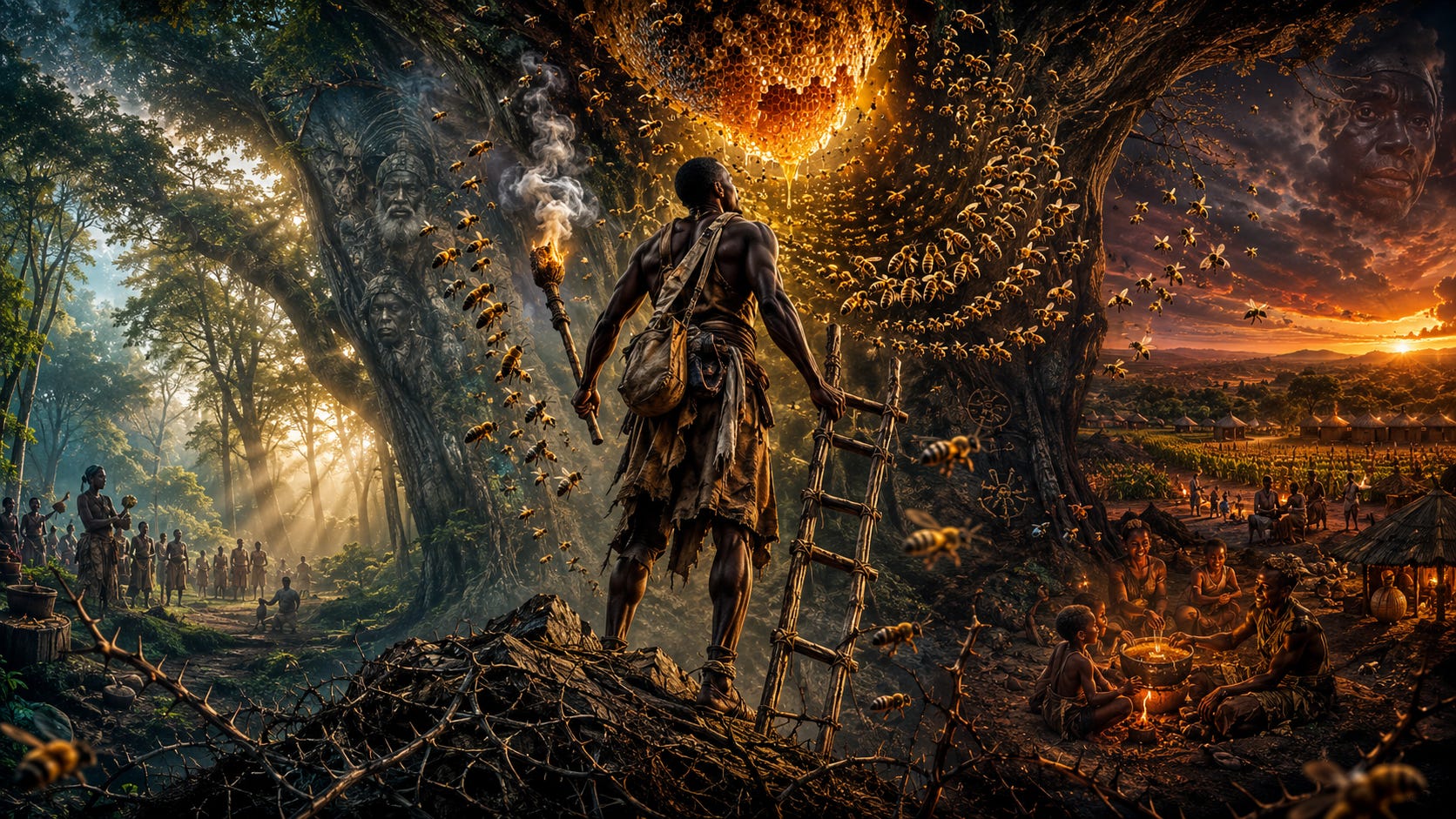
Today is World Bee Day—an opportunity to honor both Blackness and “Beeness”, and to celebrate the long, buzzing relationship between our communities and these small, tireless keepers of sweetness.
The United Nations proclaimed May 20 as World Bee Day in 2017 to recognize the vital role of bees and other pollinators in sustaining ecosystems and feeding the world. However, it also opens a portal to histories that are rarely acknowledged: Black people tending hives on plantations, Tuskegee students learning discipline and sovereignty through beekeeping, and Michelle Obama’s beehive quietly humming on a lawn built by African hands.
In following the bees through the lens of Blackness, we journey from rural Africa to Detroit’s vacant lots, from women in Tanzanian bee suits to a Nigerian computer scientist who studied the geometry of honeycomb as a blueprint for the internet. Along the way, it becomes clear how much of our shared history with bees has been hidden in plain sight—scattered across footnotes and local projects rather than gathered into a single, shimmering hive of memory.
On this World Bee Day, I’ve not run off in fear because of the buzzing in my ear! Instead, I have stayed still long enough to listen to the hive: to learn the history of Black bee educators and scientists, to celebrate contemporary Black beekeepers and projects, to spotlight African women forging livelihoods with bees, and to trace a few cultural figures whose work has been quietly shaped by honey and honeycomb. This is, it is hoped, a small offering of gratitude to the bees—and to the Black people who have worked alongside them, often without recognition, for centuries. Their bravery is profound, in ways too often overlooked.
About Bees: Small Bodies, Big Worlds
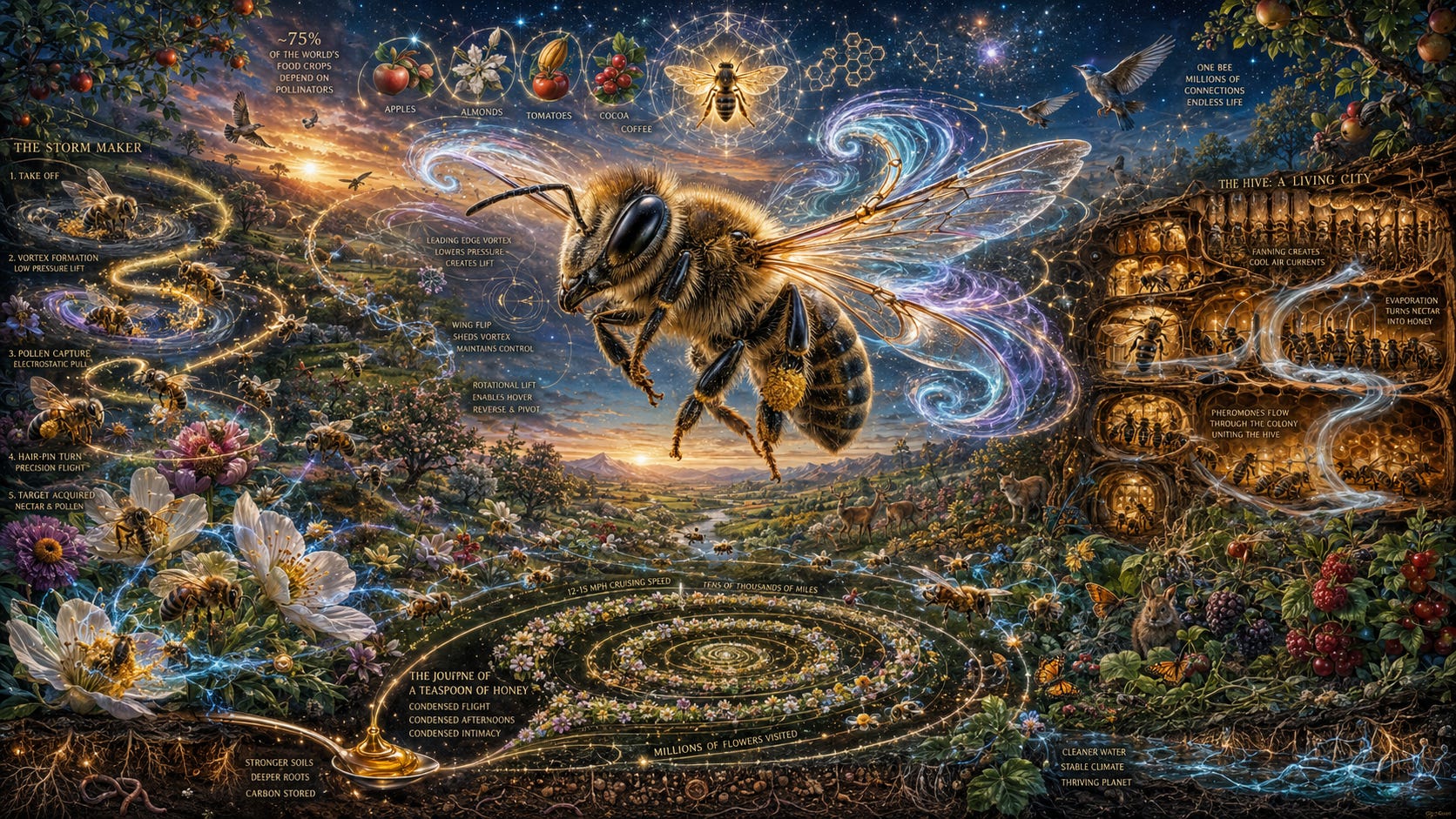
Bees may be small, but their flight, work, and significance are immense. Look closely and you’ll see that bees are not minor creatures at the margins, but some of the world’s greatest engineers.
How bees really fly
By airplane standards, bees shouldn’t be able to fly—their bodies are too bulky and their wings too small. Yet bees are masters of turbulence, creating and riding tiny airstorms. Each bee’s four wings hook together into flexible “super-wings,” beating up to 240 times per second in short, angled, figure-eight strokes that generate powerful air vortices. This wing work lets bees hover, reverse, and carry loads heavier than themselves—a feat no plane can match. Every bee is a storm-maker, drifting from flower to flower on miniature whirlwinds.
Delicious bee facts
The more one watches bees, the more fascinating they become. A foraging honeybee flies at about 12–15 miles per hour and may visit thousands of blossoms each day with astonishing precision, following learned routes rather than wandering aimlessly. To make a single pound of honey, bees collectively travel tens of thousands of miles and visit millions of flowers—every teaspoon contains the labor of countless journeys.
As they fly, their rapid wingbeats generate a positive electric charge, causing pollen to cling to their bodies and making them ideal pollinators by design. Inside the hive, they use their wings to ventilate, cool, and dry nectar into honey, while also spreading pheromones, turning the hive into a coordinated, air-conditioned city of scent and sound. Beneath all this activity is remarkable intelligence: bees learn scents and colors, remember profitable patches, and navigate using the sun and landmarks. No single bee knows everything, but together they form a distributed mind, pooling their perceptions into a coherent, responsive whole.
Why bees matter to the environment
Bees’ true importance lies in pollination—the quiet engine behind life on Earth. By transferring pollen, bees enable plants to produce seeds and fruit, supporting countless wild plants and roughly three-quarters of the major food crops humans rely on. When bees thrive, so do orchards, berries, and future generations of plants and animals.
Their work ripples through entire food webs, sustaining birds, mammals, and insects, and nourishing soils, water, and the carbon cycle. Bees are also sensitive indicators of environmental health; their decline signals bigger problems—habitat loss, pesticides, climate disruption, and disease threaten the entire web of life. Caring for bees means protecting wild habitats, rethinking agriculture, limiting the use of harmful chemicals, and remembering that food starts with pollinators, not supermarkets. Learning about bees deepens our connection to the living world; every time we plant flowers or savor honey with gratitude, we join their shared ecology.
Historical Black bee educators and scientists
Throughout Black histories, bees emerge as quiet collaborators—teachers of patience, models of cooperation, and guardians of sweetness amid adversity. Long before “World Bee Day” appeared on the calendar, Black farmers, scientists, and educators treated the hive as a living text: studying its geometry, tending its fragility, and drawing vital lessons for survival and liberation.
At Tuskegee Institute in Alabama, beekeeping was woven into a radical curriculum for Black self-determination. George Washington Carver and his colleagues championed bees as partners in soil restoration and crop diversification, integrating apiculture into a broader vision of ecological repair. In 1892, Margaret Murray Washington, Dean of Women and wife of Booker T. Washington, established the Lady Beekeeper Club, insisting that Black women students handle hives with such confidence that the group became known for working bare-faced, without veils.
Alongside these agrarian projects, Black scientists quietly remapped what is known about bees themselves. Charles Henry Turner, often omitted from mainstream histories of science, conducted pioneering experiments demonstrating that honey bees can see color, learn patterns, and navigate complex mazes. His research overturned racist assumptions that both insects and Black people were somehow “less intelligent,” instead revealing minds—human and non-human—capable of memory, learning, and choice.
And then there is Philip Emeagwali, the Nigerian computer scientist whose engagement with bees is connected to the architecture of supercomputers.
Philip Emeagwali and the honeycomb mind
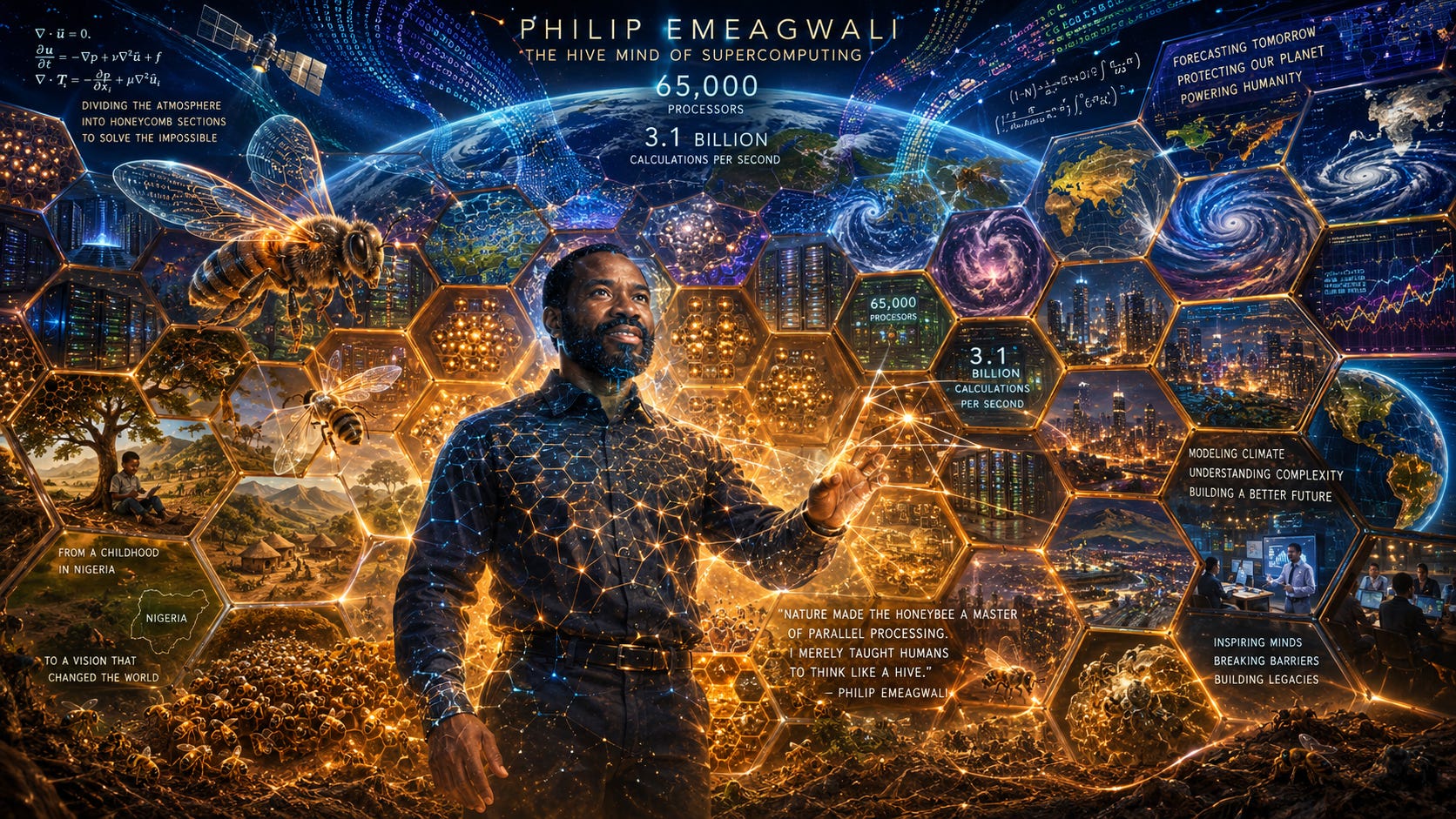
As a boy in Nigeria, Emeagwali turned to nature as his first teacher. Among his earliest influences were bees—specifically, their construction and use of honeycomb. Decades later, faced with the challenge of coordinating tens of thousands of processors to work together on a single problem, he returned to the honeycomb. Emeagwali described “reverse engineering the bees’ honeycomb,” exploring what it would mean to treat each processor like a bee in a hive.
In 1989, he implemented a computational “honeycomb” with 65,000 processors working in parallel, achieving 3.1 billion calculations per second—then the world’s fastest computer performance, recognized with the Gordon Bell Prize. The architecture he developed was not a singular heroic machine but a swarm: a network of nodes passing information, mirroring both the structure of a honeycomb and the collective intelligence of the hive.
For Emeagwali, the bees provided a blueprint. Studying how they cooperated and how information flowed through the comb allowed him to translate those insights into a topology for routing data across thousands of processors.
Contemporary Black beekeepers and projects
Across the diaspora today, a new generation of Black beekeepers is reclaiming bees as companions in the healing of land, bodies, and memory. Their apiaries flourish not only in rural fields, but also on vacant city lots, rooftops, and schoolyards—transforming sites of neglect into vibrant, humming sanctuaries.
In Detroit, Timothy Paule Jackson and Nicole Lindsey founded Detroit Hives by connecting the medicinal value of local honey with a broader vision to restore neglected urban land. They turned vacant lots into thriving bee farms and educational spaces.
Kamal Bell’s work at Sankofa Farms in North Carolina stands out for weaving together beekeeping, Black agrarian memory, food justice, and youth education into a vibrant, living practice. Bell founded the 12-acre farm as both a food-producing space and an educational environment for young African American men. His journey into beekeeping reportedly began when a student expressed interest in bees, prompting him to earn certification and share that knowledge throughout his family and community. Sankofa’s compelling power lies in how Bell frames access to land, food production, and ecological knowledge as part of a broader process of Black reclamation—embracing the Akan meaning of “Sankofa” by recovering what has been left behind to build a more sovereign future.
On the community-building front, Karyn Bigelow’s Beekeeping While Black platform addresses the isolation many Black beekeepers experience in predominantly European hobbyist and agricultural spaces. Established in 2022, the platform connects Black apiarists across regions, provides mentorship to novices, hosts seminars on the economic and mental health benefits of beekeeping, and curates a directory called The Honey Book. Bigelow’s work asserts that beekeeping is an integral part of Black ecological presence—one that demands visibility, support, and intergenerational continuity.
Taken together, these projects reveal that contemporary Black beekeeping is about much more than honey production. It is about reclaiming land after dispossession, rebuilding community after fracture, and restoring relationships with the natural world—bonds that histories of captivity, segregation, and environmental exclusion have sought to sever.
African women beekeepers
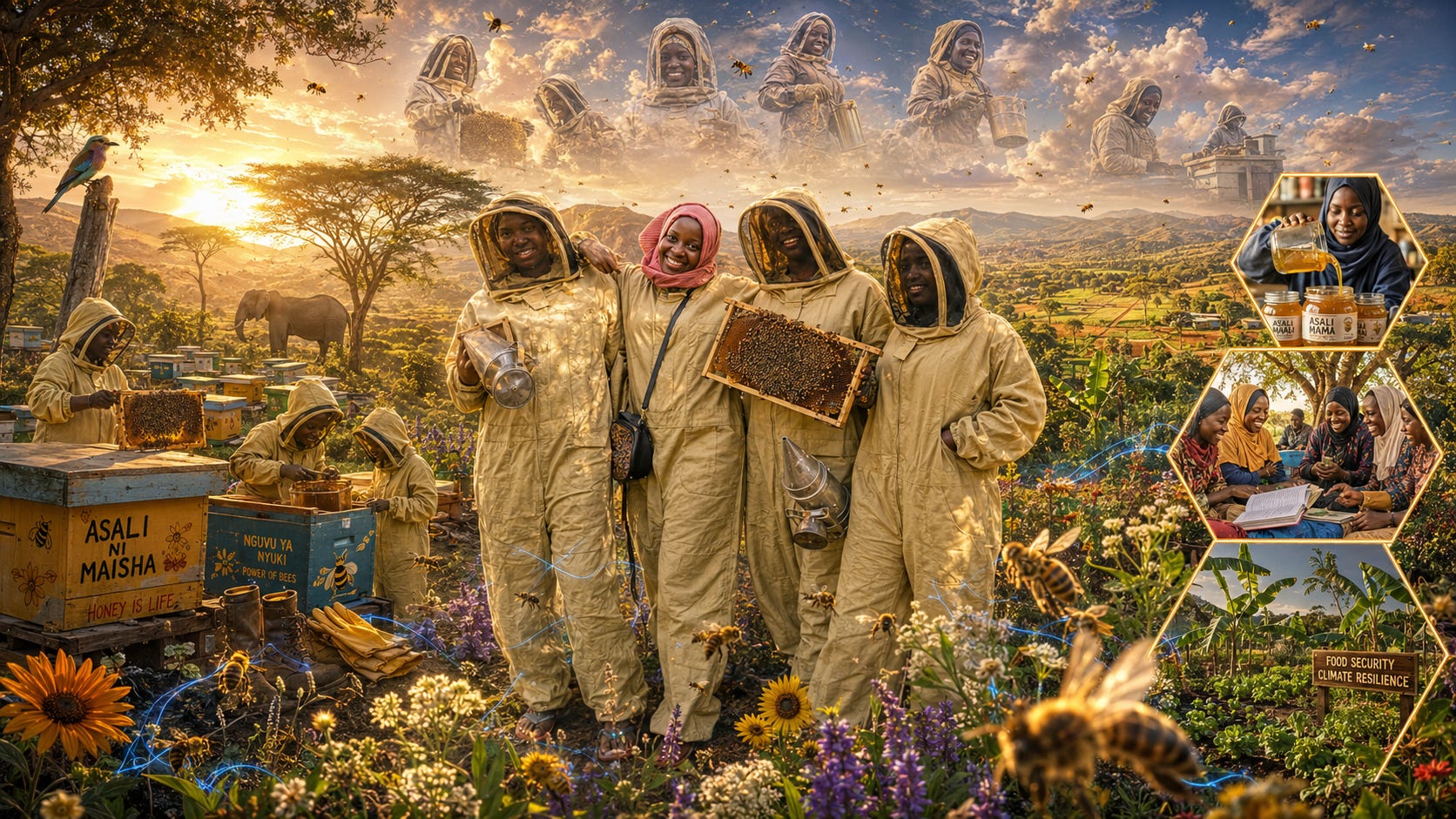
Across Africa, the figure of the beekeeper is increasingly and powerfully female. Organizations such as CAMFED (Campaign for Female Education) spotlight young women in Ghana, Tanzania, and beyond who have transformed beekeeping into climate-resilient livelihoods. These women manage apiaries, harvest honey and wax, and train their peers—often in regions where drought and economic uncertainty make every extra income stream vital for survival.
In a CAMFED profile, three young Tanzanian women—Halima, Stella, and Neema—describe bees not merely as business partners, but as part of a deeper relationship. They speak of the patience needed to read the skies, track the flowering seasons, and sense the moods of the hive—attentiveness that shifts their sense of agency in communities where they were once seen only as dependents. Their honey pays school fees, covers household needs, and enables reinvestment into more hives, turning the apiary into a small but powerful engine of intergenerational change.
Similarly, Kenyan beekeeper-entrepreneurs such as Margaret Mwuara have become leaders in training other women to enter the field. Through workshops and cooperatives, they demystify beekeeping technology—from modern hives to protective gear—and insist that women’s labor with bees deserves formal recognition and fair prices in national honey markets.
Cultural figures linked to bees
Some cultural figures are not beekeepers themselves, yet remain closely linked to bees in the public imagination—whether through policy, symbolism, or metaphor. Michelle Obama, for example, introduced a beehive to the White House garden in 2009. For Black observers, the image of a Black First Lady nurturing bees on a lawn built by African labor carried profound resonance. On that lawn, Beeness and Blackness met in public view, even if many did not yet have the language for what they were seeing. Her hive quietly educated a generation of schoolchildren visiting the garden, connecting nutrition, environmental health, and the tangible delight of tasting honey harvested just meters away.
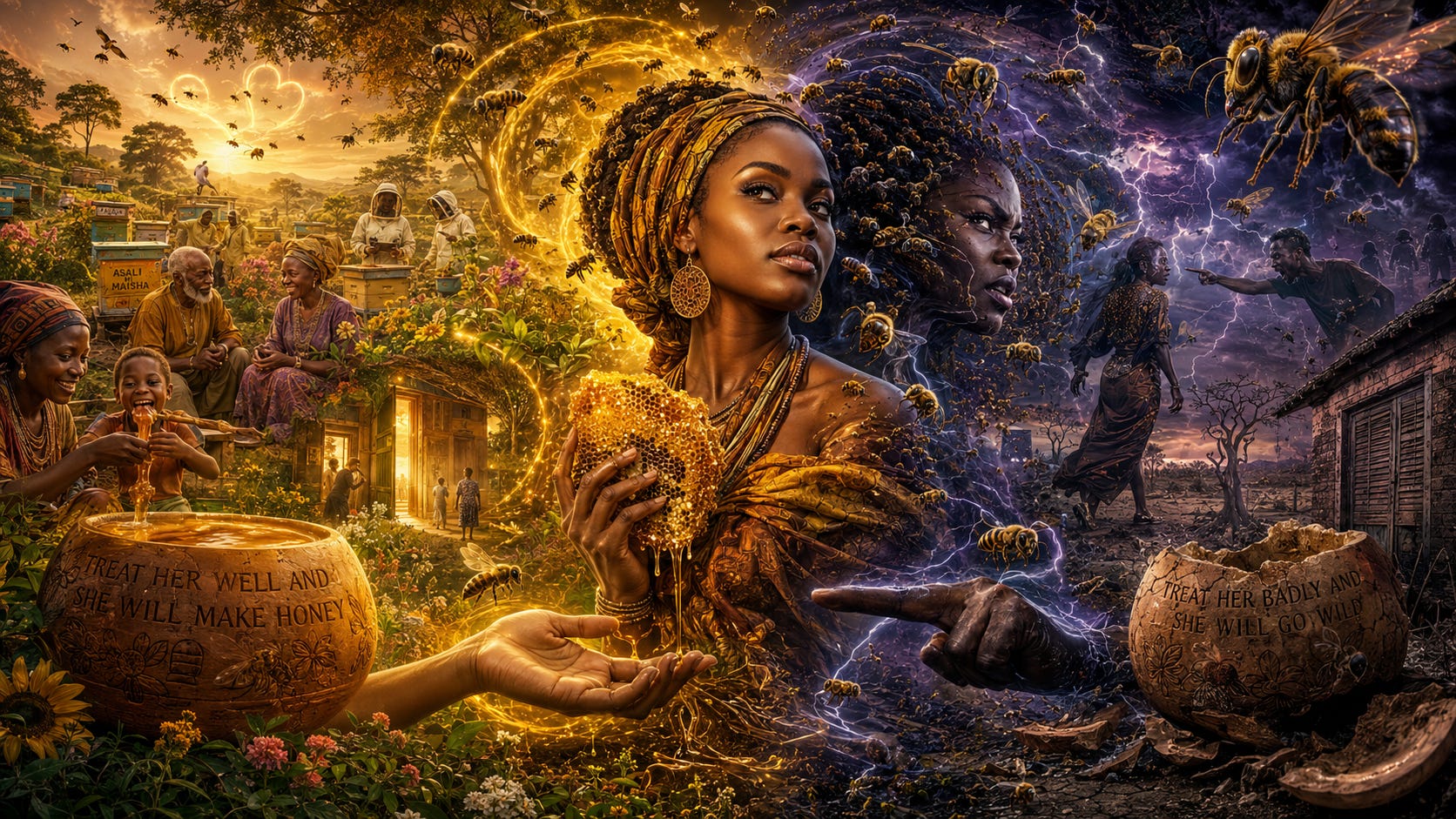
African proverbs that celebrate bees
One of the best-known quotes about bees comes from Muhammad Ali’s legendary boxing mantra: “Float like a butterfly, sting like a bee—his hands can’t hit what his eyes can’t see.” However, there are also African proverbs that celebrate the wisdom and industriousness of bees:
“A woman is like a bee: treat her well and she will make honey; treat her badly and she will go wild.”
Meaning: respect and care bring out people’s sweetness; mistreatment brings out their sting.“Whoever stands in need of honey should not be afraid of bees.”
Meaning: Sweetness and reward often require risk.“Bees sting him who loves honey.”
Meaning: The pursuit of pleasure or reward can bring pain.“The bee that carries honey in its mouth carries a sting in its tail.”
Meaning: What nourishes and delights may also carry danger or responsibility.“A man doesn’t escape from bees with a lump of honey in his hand.”
Meaning: Benefits and risks are often inseparable.“If the honey is sweet and the bees are absent, look twice.”
Meaning: Be wary of rewards that seem to come without cost.“The bee is the doctor of flowers.”
Meaning: Bees heal and sustain the natural world through pollination.
On this World Bee Day, I find myself reflecting on the ways bees connect us to Black history. Our ancestors’ deep relationship with nature was rooted in its ability to teach. A tree can tell a story about our history if one knows how to read it. Like bees, Black history transcends borders—its lessons, struggles, and triumphs are global. Black writers and artists have been ensuring that our story is now humming throughout the world. Like honey, our history is sweet, even when it carries the memory of sorrow. To honor Blackness and “Beeness” together is to remember that survival has always been collective—many cells, many routes, one shared hive of memory and possibility.
Thanks for reading,
Meserette Kentake
If you enjoyed this post, please make a beeline to the Share and Subscribe buttons!
Further reading
If you love bees or want to dive deeper into learning more about Blackness and Beeness, these links are a wonderful place to begin.
How Bees and Black Folks Have a History of Working Together — Earth in Color
Beautiful, wide-ranging essay on Black beekeeping traditions from Tuskegee to Michelle Obama’s White House hive, and the new generation of Black beekeepers reconnecting land, healing, and honey.
https://earthincolor.co/earth-curiosity/how-bees-and-black-folks-have-a-history-of-working-together/
Black Beekeepers Are Reclaiming Their Relationship With the Land — Word in Black
Reporting on Detroit Hives, Sankofa Farms, and others, framing Black beekeeping as a way to heal from histories that associate Black people and the outdoors only with enslavement.
https://wordinblack.com/2023/05/black-beekeepers-reclaiming-relationship-land/
Black Beekeepers Are Transforming Detroit’s Vacant Lots Into Bee Farms — HuffPost
Profile of Detroit Hives and their work turning abandoned Detroit lots into vibrant apiaries and educational spaces.
https://www.huffpost.com/entry/detroit-hives-honeybees_n_5a6cfc9ee4b0ddb658c7019c
5 Reasons to Visit Your Local Black Beekeeper — Melanin Base Camp
Accessible piece connecting outdoor recreation, representation, and Black-led apiaries; includes links back to Earth in Color and Detroit Hives.
https://www.melaninbasecamp.com/trip-reports/2024/5/7/five-reasons-why-you-should-visit-your-local-black-beekeeper
Resources to Inspire and Support BIPOC Beekeepers — Best Bees
Curated resource list that highlights Earth in Color and other BIPOC-led land and bee projects; great for readers who might want to start beekeeping or support existing initiatives.
https://bestbees.com/resources-for-bipoc-beekeepers/
Detroit Hives (Icons of Detroit short film)
Short documentary on Tim Paule Jackson and Nicole Lindsey, showing how they “flip” vacant lots into community-driven bee conservation and education spaces in Detroit.
Black Beekeepers Are Reclaiming Their Relationship With the Land — San Diego Voice & Viewpoint
Another strong reported piece on the history of enslaved Africans as beekeepers, Tuskegee’s beekeeping curriculum, and contemporary projects like Sankofa Farms.
https://sdvoice.info/black-beekeepers-are-reclaiming-their-relationship-with-the-land/
Beekeeping While Black — Modern Farmer profile
Story on Karyn Bigelow’s “Beekeeping While Black” platform and the push to diversify beekeeping communities.
https://modernfarmer.com/2023/11/beekeeping-while-black/
Beekeeping While Black — Food Tank article
Explains how the online platform connects Black beekeepers and offers resources, mentorship, and visibility.
https://foodtank.com/news/2024/05/an-online-platform-diversifies-beekeeping-through-a-virtual-network-of-black-apiarists/
CAMFED: Young Women Beekeepers in Rural Africa
Video and blog introducing young women in Tanzania and Ghana who are building climate-resilient businesses through beekeeping.
https://camfed.org/world-bee-day-2022/
How Bees and Black Folks Have a History of Working Together — Earth in Color
Also a key source for the Michelle Obama detail: it notes that she established a beehive at the White House in 2009, linking the kitchen garden to pollinator health and Black foodways.
https://earthincolor.co/earth-curiosity/how-bees-and-black-folks-have-a-history-of-working-together/
White House Kitchen Garden — National Park Service
Background on the garden planted by Michelle Obama, including confirmation that the White House keeps bees and produces its own honey.
https://www.nps.gov/whho/learn/historyculture/white-house-kitchen-garden.htm
This Man Is Hot — Philip Emeagwali (New African profile on his site)
Explains how his supercomputer work divided the Earth’s atmosphere into sections “that simulate a bee’s honeycomb,” because bees use one of the most efficient methods of construction.
https://philipemeagwali.com/europe/england/new-african.html
Zora & Real-Life Black Beekeepers — Anna McQuinn
A children’s-book-adjacent page that mentions Emeagwali learning from bees and modeling computing networks on honeycomb.
https://www.annamcquinn.com/zora--real-life-black-beekeepers.html